on accidental megastructures, the blurring of time, and combating accelerationism
absolu, sans cet idéalisme qui confère son titre au dernier cha- pitre de la phénoménologie de Hegel. Celui qui traite de l'absolu ne dit-il pas nécessairement que l'organe pensant dont on affirme qu'il le maîtrise est justement par là lui-même l'absolu ? D'autre part la dialectique, dans le passage à une métaphysique qui ne serait pas simplement assimilable à la dialectique, ne man- querait-elle pas à son concept rigoureux de négativité ? La dia- lectique, ensemble du savoir négatif, ne voudrait rien avoir d’autre à côté d’elle ; même en tant que négative, elle continue à traîner avec elle l’impératif de l'exclusivité provenant de la dia- lectique positive, du système. Selon un tel raisonnement, elle devrait nier la conscience non-dialectique comme finie et faillible. Dans toutes ses figures historiques, elle a empêché qu’on sorte d’elle. Qu'elle le veuille ou non, elle fut sous la forme du concept, la médiation entre l’esprit inconditionné et l'esprit fini ; cela fit de la théologie un ennemi toujours résurgent. Bien que la dialectique pense l’absolu, celui-ci reste, comme étant ce qui est médiatisé par elle, assujetti au penser conditionné. Si l’absolu hégélien était la sécularisation de la divinité, il en fut bien préci- sément la sécularisation ; comme totalité de l'esprit, cet absolu resta enchaîné à son modèle humain fini. Mais si la pensée, en ayant une pleine conscience de cela, essaie d’aller au-delà d'elle- même, en sorte qu’elle désigne l’Autre comme quelque chose qui lui est absolument incommensurable, alors que pourtant elle le pense, elle ne trouve de refuge nulle part ailleurs que dans la tra- dition dogmatique. Dans une telle pensée, le penser est étranger à son contenu, irréconcilié, et se trouve à nouveau condamné à une vérité double qui serait incompatible avec l'idée du di a métaphysique dépend de la question de savoir s'il est possible de : | ion. Pour ce faire, la dialectique sortir de cette aporie sans subreption. k Le à'la fois reproduction du rapport d’aveuglement universe ie tique de celui-ci, doit en un dernier mouvement se Le re elle-même. La critique de tout particulier que AA la absolu, est la critique de l'ombre de l’absoluité sur e ie ss critique de ce qu’elle aussi, à l'encontre de son caractère,
nécessairement demeurer dans le medium du concept. Elle détruit la prétention à l'identité en y satisfaisant pour l'éprouver. C’est pourquoi elle ne va pas plus loin que cette prétention. Comme cercle magique, celle-ci empreint la dialectique de l’ap- parence du savoir absolu. C’est à l’autoréflexion de la dialectique que revient d'effacer cette apparence, étant justement en ceci négation de la négation qui ne se transforme pas en position. La dialectique est la conscience de soi du rapport d’aveuglement objectif, elle ne s’en est pas encore échappée. S’en évader de l’in- térieur constitue son but objectif. La force de s’en dégager lui provient du rapport d'immanence ; il faudrait encore une fois lui appliquer les mots de Hegel, que la dialectique absorbe la force de l’adversaire, la retourne contre lui; non seulement dans le moment dialectique singulier mais aussi finalement dans le tout. Elle saisit avec les moyens de la logique son caractère contrai- gnant en espérant qu'il cède. Car cette contrainte est elle-même l'apparence mythique, l'identité forcée. Cependant l’absolu, tel que la métaphysique se le représente, serait le non-identique qui ne surgirait qu'après la disparition de la contrainte de l'identité. Sans thèse de l'identité, la dialectique n’est pas le tout ; mais alors ce n’est pas non plus pour elle un péché capital d'abandonner cette thèse dans un pas dialectique. Il appartient à la détermina- tion d’une dialectique négative de ne pas se reposer en elle- même comme si elle était totale ; c’est là sa figure d’espérance. Dans la doctrine de la chose-en-soi transcendante au-delà des mécanismes d'identification, Kant a noté quelque chose de cela. Autant la critique de cette doctrine par ses successeurs fut rigou- reuse, autant ils renforcèrent l'emprise, tout aussi régressifs que la bourgeoisie post-révolutionnaire dans son ensemble : ils hypo- Stasièrent la contrainte elle-même comme absolu. Certes Kant a POUr Sa part conçu, dans la détermination de la chose-en-soi comme essence intelligible, la transcendance comme non-iden- tique, mais il l’a assimilée au sujet absolu et s’est donc encore incliné devant le principe d'identité. Le processus de la connais- sance qui est censé s’approcher de façon asymptotique de la chose transcendante, la repousse pour ainsi dire devant soi et l'éloigne de la conscience. Les identifications de l’absolu le trans- posent en l'homme d'où provient le principe d'identité ; elles sont des anthropomorphismes, comme elles le reconnaissent par- fois et comme l’Aufklärung leur en fit à chaque fois le reproche pertinent. C'est Pourquoi l’absolu dont l'esprit s’approche s’éva- Fr devant lui : SOn approche est réfléchissement. Cependant
Dialectique négative | 389 serait ce ne le rapport d’aveuglement, coïn semblablement avec ce dernier, avec l'identité i mystère par l'identification, en lui Fine bribes, ne le résout pas. Com
La métaphysique, de par son propre concept, n’est pas possible comme chaîne des jugements déductifs sur l’étant. Elle ne peut pas davantage être pensée sur le modèle d’un absolument diffé- rent qui serait un défi effrayant pour le penser. Aussi la métaphy- sique ne serait-elle possible que comme constellation lisible de l'étant. De l’étant elle recevrait la matière sans laquelle elle ne serait pas mais elle ne transfigurerait pas l’existence de ses élé- ments, au contraire, elle en ferait une configuration dans laquelle les éléments se rassemblent en écriture. Pour ce faire, elle doit s’entendre sur ce qu’elle désire. Que le désir soit un mauvais père de la pensée, est depuis Xénophane l’une des thèses générales de l’Aufklärung en Europe et elle continue de valoir sans restriction face aux tentatives de restauration ontologique. Mais le penser qui est lui-même un comportement, contient en lui le besoin — et en premier lieu la nécessité vitale. On pense à partir du besoin, même quand le wishful thinking est rejeté. Le moteur du besoin est celui de l'effort qui comprend le penser comme faire. C’est pour cette raison que l’objet de la critique n'est pas le sr dans le penser mais le rapport entre les deux. Mais le besoin ne le penser veut qu’on pense. Il exige sa négation par nos ; faut qu’il disparaisse dans le penser si toutefois il doit rée .
se satisfaire, et dans cette négation il perdure, il soutient res a cellule la plus intime de la pensée ce qui n'est pas Le PEROU = Les traits intramondains les plus infimes auraient leur impo
tance pour l’absolu car le regard micrologique déchire les enve- loppes de ce qui, selon le critère du concept générique qui sub- sume, reste désespérément isolé, et fait éclater son identité, l’illu- sion selon laquelle il serait un simple exemplaire. Un tel penser est solidaire de la métaphysique à l'instant de sa chute.
1. C£ KANT, Kritik der reinen Vernunfi, 2° éd., W WIII, Akademie-Aus- gabe (Troisième chapitre de la Théorie transcendantale de la méthode) : trad. Tremesaygues et Pacaud, Critique de la raison pure, PUF, 1965, p. 561-562.
2. C£ F. A. TRENDELENBURG, Logische Untersuchungen, tome I, Leipzig, 1870, p. 43 sqq., 167 sqq.
3. C£ Benedetto CROCE, Lebendiges und Todes in Hegels Philosophie, traduction (allemande) de K. Büchler, Heidelberg, 1909, p. 66 sqq., 68 sqq., 72 sqq., 82 sqq.
4. C£ HEGEL, W W4, p. 78; trad. Jankélévitch, Science de la logique, Aubier, 1947, tome I, p. 63 (traduction revue).
the stack
Benjamin Bratton’s “The Stack” views the world as an accidental megastructure which does computation. When he discusses the Earth layer of the stack, his allusion to Turing Machines implies that he sees computation as the progression of states, but I read it instead with a different, equivalent model: lambda calculus. In lambda calculus, computation is the evaluation of functions which recieve functions as inputs and produce functions as outputs.
To Bratton, the stack consists of layers. I understand this to be less a matter of independent strata which each contain mutually exclusive sediments, but instead different spatial and temporal scales that we can view the same sediments from. In this sense, a sediment in the user layer could be a human, but a sediment in the interface layer could be that same human insofar as they function to transmit data from one user to another (as in an influencer advertising a brand to a media consumer), and then perhaps their own personal brand constitutes one address in digital-cultural space. I’m not entirely sure if they could act as a city or cloud, but then if we just consider them as a physical entity, their material existence contributes to the autophagic consumption of the earth layer. In my view, layers are similar to, but distinct from systems, as in general systems theory.
In general systems theory, systems, like the media system, operate at various sizes and speeds: they have users, as media consumers, next to interfaces as media contents, next to addresses as media platforms, next to cities as media infrastructure (I think?), next to clouds as the space that the media system inhabits in culture, ideology and logic, and then next to the earth as the material footprint of the media system. If we view the stack as consisting of horizontal layers stacked vertically (which I think is maybe not the greatest diagram, but I have no idea how I’d rather map it out) then systems would be vertical slices of associated parts of the stack.
A picture used to represent the stack reminds me of the traditional visualization for neural networks, where the neural network consists of input layers—in this case the earth layer—hidden layers, and output layers—in this case the user layer—and you can study, in the math, how the inputs flow through model and then produces some output, which reveals on a real level the ways that raw data is converted into the desired concept.
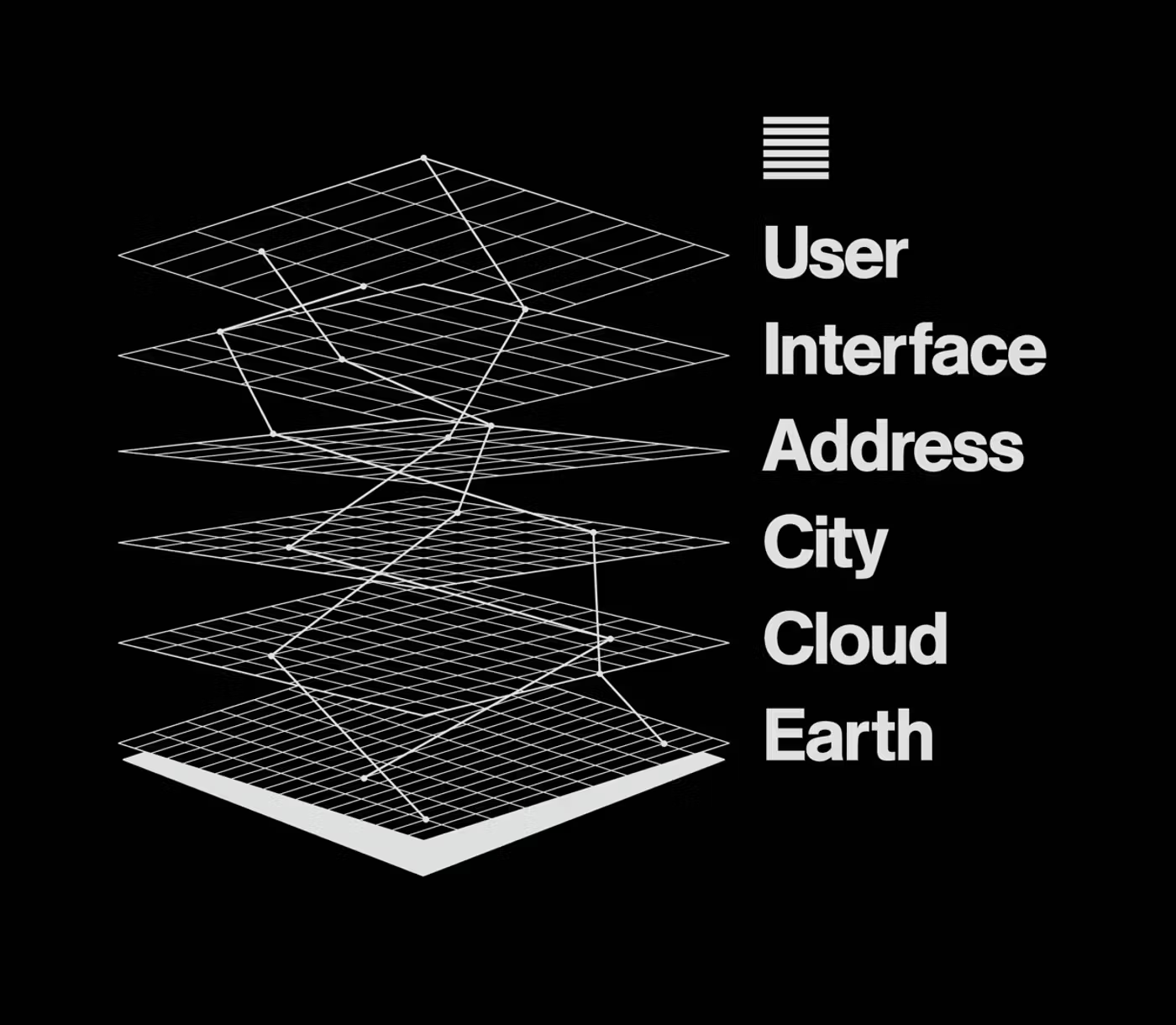 Bratton describes the stack’s construction as accidental. My vague understanding of the world from a systems theoretical perspective is that the systems which are able to propogate themselves (autopoietic) are always-already the ones that exist, so they are always-already running out of space to grow outwards, so they are always-already intertwining with each other accidentally.
5. Cf. Theodor W. ADORNO, Zur Metakritik der Erkenninistheorie, Stutt- gart, 1956, passim.
6. HEGEL, W W6, Heidelberger Enzyklopädie, p. 28; trad. Gibelin, Précis de l'encyclopédie des sciences philosophiques, Vrin, 1967, p. 40.
7. KANT, Kritik der reinen Vernunfi, 1" éd., W WIV, Akademie-Ausgabe, P. 11 ; trad. Tremesaygues et Pacaud, Critique de la raison pure, ibid., p. 8.
9. C£ Karl MARX, Das Kapital I, Berlin, 1955, p. 621 sq. Karl MaRXx/Frie- drich ENGELS, Kommunistisches Manifest, Stuttgart, 1953, p. 10 ; trad. Roy, Le Capital, Livre I, G.F,, 1969, p. 428.
10. KANT, Kritik der reinen Vernunfi, 2° éd., W W IL, ibid., p. 109; trad. Tremesaygues et Pacaud, Critique de la raison pure, ibid, pl.
11. Cf Ed. ZELLER, Die Philosophie der Griechen, 2. 1, Tübingen, 1859,
. 390. ; 12. Trad. Robin, Œuvres complètes, Pléiade, 1954, tome II, p. 62, Phèdre, 265 e. . .
13. HEGEL, W W 4, p. 402 ; trad. Jankélévitch, Science de la logique, tome I, ibid., p.364 (traduction revue). | | kilos
14. WW8, p. 217; trad. Bourgeois, Encyclopédie des sciences philoso- phiques, La science de la logique, Vrin, 1970, p. 524.
15. C£ W W4, p.291 sq. ; trad. Jankélévitch, Science de la logique, tome I, ibid, p. 262 sq. (traduction revue).
accelerationism
In the introduction to his book, he introduces a term that I think deserves to sing.
blur: “this oscillation between the real-but-as-yet-unnamed, and the imagined-but-as-yet-not-real.”
To him, blurring is both a way of comprehending the stack, and a way of reprogramming it. I think that blurry thinking is like glitch thinking, taking place in the (mis)communication between layer of the stack. I’ll do my best to explain how I understand blur, and give some examples of it, but first I need to give context on accelerationism. In “The Stack,” Bratton engages with accelerationism, and in my view, confronts it.
The cutest description of accelerationist logic that I’ve encountered unsurprisingly comes from Maya Kronic and Amy Ireland’s Cute Accelerationism, where they write: “the paradox of voluntary surrender to the inevitable is not a performative contradiction or a knock-down argument against accelerationism, but the very topology of its anastrophic passion. The backwash of anticipative intensity tugs you into the current so that whatever forms downstream will always have been inevitable” (6). In an end note, they elaborate with a quote from Nick Land and Sadie Plant: “catastrophe is the past coming apart, anastrophe is the future coming together.” This logic of voluntarily surrendering to the inevitable and watching the future come together is, in my reading, basically the object of the following (long) paragraph from Bratton.
16. C£ Theodor W. ADORNO, Thesen über Tradition, in Insel Almanach auf das Jahr 1966, Frankfort, 1965, p. 21 sqq.
ns, Pfullingen, 1954, p.7 ; trad. Préau, L'Expérience de la pensée, in Questions III, Gallimard, 1966, p.21.
2 Cf HEIDEGGER, Vom Wesen des Grundes, Frankfurt a p.14 ; trad. Corbin, Ce qui fait l'être essentiel d’un Questions I, Gallimard, 1974, p. 100.
3. HEIDEGGER, Platons Lehre von der Wahrheïr, 2° éd., Bern, 1954, p.76; trad. Munier, Lettre sur l'humanisme, Aubier, 1967, p. 77.
4. Karl Heinz HAAG, Kritik der neueren Ontologie, Stuttgart, 1960, p.73.
5. C£ HEIDEGGER, Was heisst Denken ?, Tübingen, 1954 ; p. 57 ; trad. Bec- ker et Grenel, Qu’appelle-t-on penser ? PUF, 1967, p. 98.
7. KANT, Kritik der reinen Vernunfi, WW IV, Akademie-Ausgabe, p.233; trad. Tremesaygues et Pacaud, Critique de la raison pure, ibid. p. 299.
8. HEIDEGGER, Einführung in die Metaphysik, Tübingen, 1958, p. 31 ; trad. Kahn, Introduction à la métaphysique, Gallimard, 1958, p. 51.
9. NIETZSCHE, Gesammelte Werke, München, 1924, tome 12, p. 182, Apt. 193 ; trad. Henri Albert, Le Gai Savoir, Mercure de France, 1921, p.211.
10. C£ HEDEGGER, Holzwege, Frankfurt am Main, 1950, p. 121 sqq. ; trad. Brokmeier, Chemins qui ne mènent nulle part, Gallimard, 1962, p. 111-112.
For this investigation, that compound image [blur] is articulated through the lens of computation operating at planetary scale (which it does very unevenly). But this is also exactly what makes the question of that future more difficult to ask with precision because it is also too easy to ask. To say that the future of geopolitics is a function of the future of computation is to risk saying nothing at all or, worse, to repeat everything that shouldn’t have been said in the first place. Isn’t the conflation of globalization with “digital,” under a rubric that cajoles allegiance to a computational teleology, today’s quintessential nonthought, a mere sequencing of the most obvious into something that stands for history because it renders the mundane for us at a historical scale? Yes. Yet if looking from the future at the present instead of the present for the future, we were to consider that exact situation from the virtual perspective of a world already utterly realigned, we would see plainly that a fundamental and computationally determined realignment of our world is already well underway. Where it goes is anything but settled, and today’s official futurism may have little to contribute when all is said and done. We can, however, say a few things about where it goes with some confidence. This future-antecedent revision of political geography owes itself to a calibrated repetition, a desimulation, of the blur noted above in at least two ways. First, it is realized within a tangible geographic agency of material computation, a physical information geology, that is already at work, already spoken about ad nauseam and so therefore escapes adequate description; second, it is today latent in some possible articulation that could give it formal composability in advance. We can hope that even as the blur confounds, that we designate it further so that it can design us in the course of its own articulation. It may be that our predicament is that we cannot design the next political geography of planetary computation until it more fully designs us in its own image or, in other words, that the critical dependence of the future’s futurity is that we are not yet available for it! It is less that the contemporary hyperbole for computational globalization is a lie, that it doesn’t truthfully describe what it purports to map, but that what it maps doesn’t yet exist. The difficulty in formulating a sufficient geopolity is a function of both what we think we know it has done (but don’t actually know because it hasn’t done that yet) and of what it has done and will do (but which we don’t know and actually don’t know how to know). Unfortunately, for learning how to know it, direct amplification in the intensity and resolution of our answers to the inevitably wrong questions will not help us.
11. C£ HEIDEGGER, Sein und Zeit, 6° éd., Tübingen, 1949, p. 27; trad. Boehm et Waelhens, L'Être et le Temps, Gallimard, 1964, p. 44.
12. HEIDEGGER, Platons Lehre von der Wahrheit ibid., p. 119; trad. Munier, Lettre sur l'humanisme, ibid. p.172.
r Metakritik der Erkenntnistheorie, Stutt- gart, 1956, p. 168. és HEIDEGGER, Platons Lehre von der Wahrheit, ibid., p. 119 ; trad. ibid, p.172.
Sein und Zeit, ibid., p. 35 ; trad. Boehm et Waelhens, L'Être et le Temps, ibid. p. 53.
17. CŒ HEDEGGER, Einführung in die Meta ik, ibi physik, ibid, p. 155; trad. Kahn, /ntroduction à la métaphysigue, ibid, p.206. $
. 127 sqq- F 20. HEIDEGGER, Îdentitüt und Differenz, 2 éd. Pfullingen, 1957 p. 47: trad. Préau, Identité el Différence, in Questions L ibid, p.286."
21. HEIDEGGER, Platons Lehre von der Wahrheit, ibid, p. 84; trad. Munier, Lettre sur l'humanisme, ibid, p. 90. |
24. Cf. par exemple Heidegger, Vom Wesen des Grundes, ibid. p.42 et 47: trad. Corbin, Ce qui fait l'être essentiel d’un fondement ou « raison », in Ques- tions I, ibid., p. 144-145.
25. C£ Kant, Kritik der reinen Vernunft, ibid, Pacaud, Critique de la raison pure, ibid. p.96.
26. C£ Adolf Loos, Sämiliche Schriften, tome premier, Wien-München, 1962, p. 278 et passim.
In terms of style, Bratton writes using the same excessively Romantic voice that more traditional accelerationists use, and it’s oppressingly abstract, at least for my lil ADHD brain, but I think the ending makes it clear that he’s trying to avoid hyperstitions—“everything that shouldn’t have been said in the first place”—and the positive feedback loops of “direct amplification in intensity” that they create when entertained without sufficient caution.
What I find so odd about Cute Accelerationism is that it seems like a book made just for me: extremely online, queer, endlessly referential to hip theorists, and quite poetic and strangely beautiful. I’m even post-qwer, it’s embarassing how much nonsense I send my friends. I resonate with cute/acc, and it kinda totally had the opposite effect on me than what it appears to intend. They write: “we are so over the self-important seriousness of lamenting the imminent loss of what is being torn apart, or labouring under the delusion that we have a choice in how all its bits and pieces are put back together.” I understand the impulse on some level, it’s very painful watching your future disappear. Their solution to that pain is to surrender to currents of joyful abandon by becoming cute.
But its very strange, you can’t actually be Cute, you can’t actually be an anime girl or a catboy. On the back of the book, they write: “nothing uncute makes it out of the near future, and the cute will no longer be remotely human.” So true bestie! although I myself am a human, (I know, ugh) i am on your side. “one of the cute ones” as some may say. btw I never noticed how kawaii your bio is till now but it would be even cuter if you followed back.
Of course, they engage with this contradiction, but not satisfyingly enough in my view, and unlike Bratton, they come out on the side of acceleration, even as they’re trying to push back against neoreactionary Unfortunate Developments. Perhaps in giving an honest and rigorous account of Cute, they overshared when they could have been myserious, unmasking the uncute in becoming-cute. I don’t think this was their goal, their end notes are way too detailed for it to be entirely post-ironic & not at all sincere, but it was their effect, for me. If acceleration works through anastrophic passion, maybe thorough analysis short circuits the short circuit.
I think understanding accelerationist logic helps how Bratton uses blur to engage with accelerationism. Let’s use e/acc, effective accelerationism as an example. e/acc postures itself as hyperstitional—that people’s belief in the inevitability of the ai god will bring it into being, so it’s the duty of young postrat ai engineers to be the first to make te ai god, so they can align it with humanity.
If we don’t engage with e/acc, this actually reinforces its hyperstitional mythos, because the question “will the ai god be aligned with us?” is too easy to ask; our silence and censorship reveals that we fear the potential of e/acc and also believe it shouldn’t have been said in the first place.
So a different approach would be to engage with it, while blurring together “the real-but-as-yet-unnamed, and the imagined-but-as-yet-not-real” which hopefully allows us to ask the right questions. In st/acc (stack accelerationism ^u^), blur-thinking involves emerging geopolitical computational forms, and whatever planetary sci-fi b rain world that you imagine is inevitable. In cute/acc, it’s the you that hurts as you objectify and are made object with the internet, consumerism, media consumption, and it’s the you that’s fully lobotomized, wireheaded, and fashioned anew at the end of “giving in to giving in (to…)”.
1. Développé par Walter BENJAMIN, Schriften I, Frankfurt, 1955, p. 366 sqq. et 426 sqq. ; trad. Gandillac, in Poésie et révolution, Denoël, 1971, p.171 sq. et 225 sq.
2. C£ Max HORKHEIMER et Theodor W. ADORNO, Dialektik der Aufklä- rung, Amsterdam, 1947, p. 26; trad. Kaufholz, La Dialectique de la raison, Gallimard, 1974, p. 32-33.
3. HÔLDERLIN, Patmos W W 2, éd. par Friedrich Beissner, Stuttgart, 1953, p. 190. ; |
4. C£ Hermann SCHWEPPENHAUSER, Studien über die Heideggersche Sprachtheorie, in Archiv für Philosophie 7,1957, p. 304.
S. HEIDEGGER, Sein und Zeit, 6° éd., Tübingen, 1949, p. 11 ; trad. Boehm et Waelhens, L'Être et le Temps, ibid, p. 21.
7. Karl Heinz HAAG, Kritik der neueren Ontologie, Stuttgart, 1960, p. 71.
9. HEIDEGGER, Platons Lehre von der Wahrheït, 2° éd., Bern, 1954, p. trad. Munier, Lettre sur l'humanisme, ibid. p. 61.
d RL s Wa TT à trad. Jankélévitch, Science de la logique, tome Libid., p.92 (traduction revue). re Begrün-
14. C à : sujet Werner BECKER, Die Dialektik von er don detem in Hegels Wissenschaft der Logik, Frankfurter De Leh Are
15. C£ Alfred ScHMipT, Der Begriff der Natur in vie rs Frankfurter Beiträge zur Soziologie. tome Il. Frankie AP CE
so What are the Right Questions to Ask?
A cute/acc example.
I’ve always hated how social media forces you to brand yourself. If you’re a woman, you’re supposed to be beautiful, so when a user curates their profile, the easy question is: “am i cute enough?”
This question takes place ontically in the gap between the user layer (social media user) and the address layer (social media profile), and temporally in the gap between the present feeling of pain in self judgment, and the hyperstitional belief that through surrender to cuting, that pain will dissipate.
So instead, I think the question which incorporates blur would be: “will i have been cute enough?”
I think this blurs together the present and the hyperstitions, and it asks the question in a future anterior, which in my view defangs the anticipative intensity that powers it. The temporality of the first question is diachronic (I’m not sure if this is a standard use of the term, but a few years ago a I half remember a professor using diachrony to mean linear sequential time, in contrast to synchrony, viewing all events at all times at once). It implies “am i cute enough (yet)?”, and I think either answer, yes or no, contains an implied (for now) demanding action.
The temporality of the second question is synchronic, implying “will i have been cute enough (just generally)?”. Here I think either answer is a lot more freeing. If you’ll never have been cute enough, then clearly some parameters of what that means to you needs to change. If you will have always been cute enough, then I view it like the nietszchean affirmation, where any single post, whether it does or doesnt conform to beauty standards, is an expression of an immanent cuteness that was there the whole time. Besides, you can always delete it later.
A st/acc example.
bratton describes a wrong question in the earth layer as: “can the stack be built fast enough to save us from the costs of building the stack?”
As Bratton illustrates with the example of computing the entire planetary climate, which would require a computer “roughly the size of paris [… consuming] so much energy that it would be the single most significant anthropogenic climate event that it itself would be modeling”, this question demands an omniscience which accidentally assembles the stack.
Instead, I think the blurry question would be: “will the stack have been built fast enough?”
You can have general vibes about the answer, informed by data or not, but I think this question makes it more clear that we can’t know until the future becomes the present. If your vibes lean no, then I think this perspective allows you to design with emergencies instead of designing for emergencies. On the other hand, if your vibes lean yes, then I think this perspective implores us to ask how the stack will have been built. As Bratton says: “the real design issues for the earth layer are not defined by how well we can calculate risk and state manage disaster, but rather how well we can engineer the path for one world to strategically fall apart into another.”
16. Karl JASPERS, Philosophie, Berlin-Güttingen-Heidelberg, 7799, p.20.
18. Cf ibid., p. 23, et Heidegger, Über den Humanismus, Frankfurt am Main, 1949, par ex. p. 17 sq. ; trad. Munier, Lettre sur l'humanisme, ibid., p. 69 sq.
19. HEIDEGGER, Sein und Zeit, ibid., p. 12; trad. Boehm et Waelhens L'Être et le Temps, ibid, p. 28. ? 20. Ibid. p. 13; trad. ibid., p. 29.
1. C£ Theodor W. ADORNO, Zur Metakritik der Erkenntnistheorie, Stutt- gart, 1956, p. 97 et passim.
2. C£ Weltgeist und Naturgeschichte, passim ; Esprit du monde et histoire de la nature, passim.
3. C£ HEGEL, WW4, ibid, p. 543; trad. Jankélévitch, Science de la Logique, ibid., tome II, p. 64 (traduction revue).
6. C£ Walter BENJAMIN, Urspruch des deutschen Trauerspiels, Frankfurt, 1963, p. 15 sqq.
7. Max WEBER, Gesammelte Aufsätze zur Religionssoziologie I, Tübin- gen, 1947, p. 30.
10. C£ MARX, Kritik des Gothaer Programms, Auswahl und Eïinleitung von Franz Borkenau, Frankfurt am Main, 1956, p. 199 sqq. ; trad. in Critique des programmes de Gotha et d'Erfurt, E.S., 1966, p. 22 sq.
11. C£ Alfred SCHMIDT, Der Begriff der Natur in der Lehre von Marx, Frankfurter Beiträge zur Soziologie, tome II, Frankfurt 1962, p.21.
blur
To recap, I think blur is a way of looking at the hyperstitions contained in the present, where—instead of viewing the present as actual and mapping out the inevitability of the future based on the virtual processes we identify in the present—we take these processes as actual and trace them forwards and backwards, identifying the aspects of the future in the present. This is likely an abuse of terminology and may obscure this idea further. Oh well. I have to abuse jargon now so I can get it out of my system before I have any readers. And maybe a dense summary will have been a nicer ending than rambling off back into nothingness…
12. C£ KANT, Kritik der reinen Vernunft, W WIII, Akademie-Ausgabe, Berlin, 1911, p. 93 sq. ; trad. Tremesaygues et Pacaud, Critique de la raison
13. C£ BENJAMIN, Deutsche Menschen. Eine Folge von Briefen, Frankfurt 1962, Postface de Theodor W. Adorno, p. 128.
14. C£ MaRX, Das Kapital, tome I, Berlin 1955, p. 514; trad. Roy, Le Capital, Livre 1, ibid, p.351.
1. ARISTOTE, Métaphysique, livre À, 983 b 33-35 ; tr. Tricot, Vrin, I, p.30.
Ausgabe p.432 ; tr. Delbos, Fondements de la métaphysique des mœurs, Dela- grave, 1970, p. 156.
rung, Amsterdam, 1947, p. 106 ; tr. Kaukholz, Dialectique de la raison, Galli- mard, 1974, p. 97.
4. KANT, Grundlegung zur Metaphysik der Sitten, ibid. p. 454 ; tx. ibid, p.195. 5. Ibid.
p.30; tr. Gibelin, Critique de la raison pratique, Vrin, 1965, p. 43.
7. Ibid. 8. Ibid. p.37 ;tr. ibid. p. 51. 9. KANT, Kritik der reinen Vernunft, 2. Auf, W WIII, Akademie-Aus-
gabe, p. 97 ; tr. Tremesaygues et Pacaud, PUF, 1975, p. 149. — Même Hegel a, à plusieurs reprises, en particulier dans l’Histoire de la philosophie, critiqué de façon radicale l’utilisation philosophique d'exemples.
10. KANT, Kritik der praktischen Vernunft, ibid, p.56 ;tr. (modifiée), p. 69. 11. KANT, Grundlegunsg, ibid, p.421 ; tr. (légèrement modifiée), p. 147. 12. Ibid. p.446, tr. ibid. p. 187. 13. KANT, Kritik der praktischen Vernunf, ibid, p.59 ;tx.. ibid. p. T2. 14. Ibid. 15. KANT, Grundlegung, ibid., p. 448 ; tx. ibid., p. 183 (légèrement modifiée). 16. Ibid. (tr. modifée). 17. KANT, Kritik der praktischen Vernunft, ibid., p.80 ; tr. ibid., p. 93. 18. C£. Walter BENJAMIN, Schriften, I, Frankfurt am Main, 1955, p. 36 sqq. 19. KANT, Kritik der praktischen vernunfi, ibid. p. 6; tr. ibid, p. 17. 20. KANT, Kritik der reinen Vernunft, p. 311:tr. ibid., p.351. 21. Ibid. 22. Ibid., p. 308 ; tr. ibid., p. 348. 23. Ibid.,p.310;tr. ibid. p. 348. 24. Ibid., p.309 ;tr., ibid., p.349. 25. Ibid, p. 311 ;tr., ibid., p. 349. 26. Ibid. ; ne 27. KANT, Kritik der praktischen Vernunfl, ibid. p. 95: 1x. ibid,, p. 108 légèrement modifiée). : ù S. Kant, REFUS ibid., p. 451 ;tr..ib id., p. 189. 19. ns : 31. Ibid. p. 114 ; tr. (modifiée), p. 129. 32. Ibid., p.99 ;tr., ibid, p. 112.
33. KANT, Kritik der reinen Vernunf, ibid., P-309 ; tr. ibid., p.349.
34. KANT, Kritik der praktischen Vernunf, ibid. P. 89 ; tr. ibid., p. 103.
38. KANT, Îdee zur einer allgemeinen geschichte in We Absicht, WW VIII, Akademie-Ausgabe, p. 20 s verselle d'un point de vue cosmopolite, tr. Piobetta, coll. « Médiations », p. 31.
42. KANT, Kritik der praktischen Vernunfi, ibid., p.36 ;tr., ibid., p. 50.
46. Ibid., p. 118 ; tr., ibid., p. 133 ; cf Horkheimer et Adorno, Dialektik der Aufklärung, ibid., p. 123 sqq. ; tr. ibid., p.110.
48. KANT, Kritik der praktischen Vernunft, ibid., p. 31; tr. ibid., p. 44; cf. sur ce point Horkheimer et Adorno, ibid., p. 114: tr. ibid., p. 104.
49. Sandor FERENCZI, Bausteine zur Psychoanalyse, Bern, 1939, Bd. IT, p.394 sqq.
53. KANT, Kritik der praktischen Vernunfi, ibid., p. 48 ;tr., ibid. p. 61. 54. Ibid, p. 67 ;tr. ibid, p- 80.
60. Ibid. p. 99 sqq. : ibid, p. 112 sqq. 6L Ibid.,p. 87, tr. ibid, p. 99.